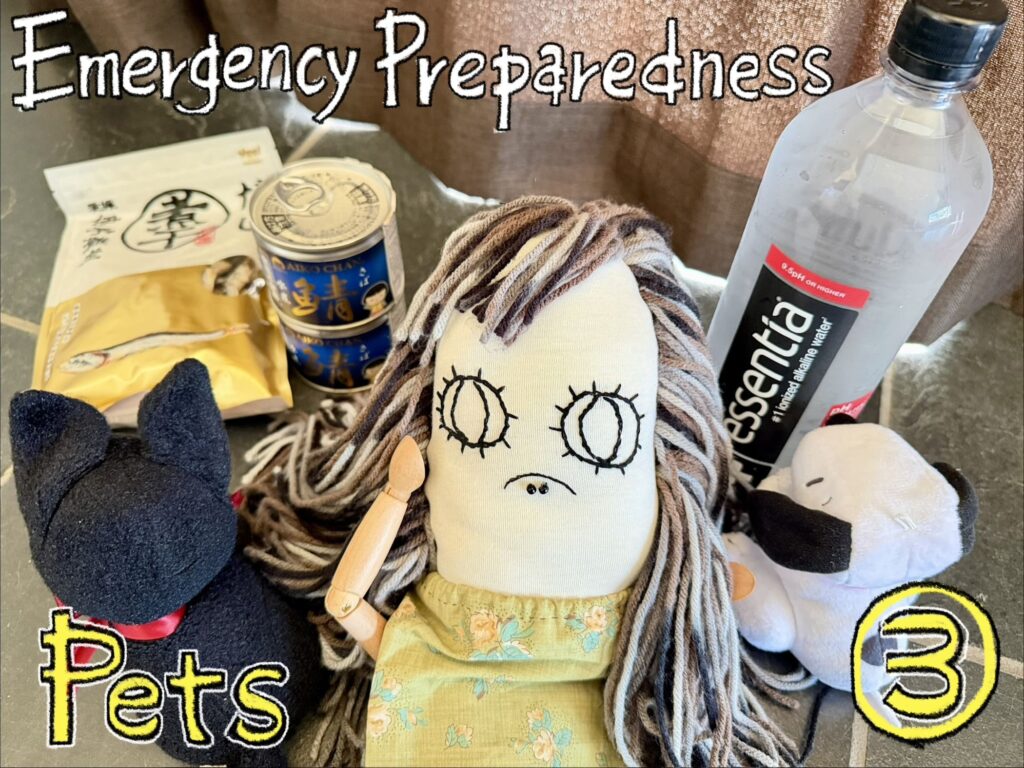
What should you prepare for your pets for an emergency?
I have two dogs… Wow! I will have to carry a huge emergency bag for an evacuation!
I asked Mumsie and Paw-paw if my cats might stay with them. But my parents are getting quite old, you see…
Hmm… I’m a-wonderin’. Will I be able to carry my dog and my big old emergency bag?
When you start to set up your emergency stockpile and evacuation bag for your pets, you will realize just how much stuff you are going to need. It’s a lot. A lot of stuff and a lot of space. The stockpile for your pets plus the supplies for your family, altogether, will occupy a lot of space in your home. The larger your family and the more pets you have, the more space you will need.
How many pets do you have? How big are your pets? How many “how’s” are there to ask about your pets?
When you start thinking what your pets will need after a major disaster, you will be surprised by many “how” questions. If you are in a panic during a disaster, or right before, and you don’t have a plan, you run the risk of bringing a bunch of extra stuff that you absolutely don’t need. You need to avoid that kind of mistake. If you haven’t prepared for an emergency yet, and you don’t have a plan, you will be in trouble when things go sideways. It’s time now to start preparing your emergency stockpile for your pets.

Emergency preparedness for pets #112

Emergency preparedness for pets #113
Things you need to prepare
These are recommendations for planing and prepping for your pet. Be careful, these recommendations will not be appropriate for all kinds of animals. I focus mainly on cats and dogs because they are the most common. There are 8,850,000 pet cats and 6,620,000 pet dogs in Japan, as of 2026. (You can find U.S. data here: Humane World for Animals). If you have other kinds of animals, please review these suggestions, and think about how you can apply them to your pets.

1. Collar, Leash, Harness, Carrier
▪︎ Your pet should always wear a collar with an up-to-date identification tag, including your phone number, visible at all times.
▪︎ You need a sturdy leash. (Your pet might freak out in an emergency and chew through or tear off their leash. Chew-proof is recommended.) Do not prepare a retractable leash for emergencies, because they are difficult to control. (For more information about retractable leashes, check out: Santa Barbara Humane.)
On 2 separate occasions, I was bitten by dogs on retractable leashes. The dog owners couldn’t control the dogs when the animals suddenly decided to attack me. They tried to push the button instead of pulling the leash directly. Some dog owner think pushing the button retracts the leash and pulls the dog back, but actually all the button does is stop the dog from going farther.


▪︎ If your dog has difficulty walking, prepare a harness to carry them, if possible, in an efficient, hands-free way. Some harnesses are hard to set up in an emergency, especially if you or your pets are panicked. I recommend trying the harness out at home and getting familiar with the initial setup. Check the fit and design for you and your pet, before a crisis, when you have plenty of time, and there’s no pressure. It’s best to get the bugs worked out before you need it; an improper fit, over prolonged periods, can be very uncomfortable and even cut off blood circulation. (Check out the Fido Pro Emergency Carrying Harness.)
▪︎ A cat harness can be extremely difficult if your cat is not used to wearing it. Cats, and especially panicked cats, need an escape-proof, quick-fitting, secure harness to prevent it from slipping off during an emergency.
▪︎ You might already have a carrier for your pet. Is it hands-free? Can you navigate difficult conditions, with your carrier and your emergency bags? It’s better to keep both hands free, to protect against a fall. Good features to have are: fast loading, secure closure, ventilation, weight-bearing comfort, and escape resistance. I recommend training with your carrier to get your pets comfortable entering and resting in their carriers, well before an emergency happens.
▪︎ You can use a mesh laundry wash bag for your cat or small animal, to help prevent them from escaping your carry bag.

2. Pet Food and Water
At least 3 days of pet food and water for evacuations, same as for humans. (See post #2.)
Evacuation bags are limited in their carrying capacity. (See post #52.) It will be hard to carry all of your emergency food, water and other supplies. If you have a big family, can you carry everything?
It’s totally up to you, whether to prepare more food and water for humans or more for your pets?
Personally, my priority is humans. I am sorry…
Emergency food prep-How much?
#2

Which foods are good for my evacuation bag?
#52
If you can share your food with your pets, it will be beneficial, because you might get emergency human food from shelters, rescue workers, or others. Emergency pet food might be hard to come by.

You should set up an emergency stockpile in your home for major crises which do not require evacuation. How much pet food and water do you need? Actually, it depends on how much space you have in your home. It’s best to use “Rolling Stock” in your daily life. (See Post #42.)

Rolling Stock #42
This may seem obvious, but remember, your pet is an animal. You need to check what kinds of food animals eat in the wild.
If you know, your knowledge will help you and your pets survive in emergency situations.
3. Toilets (Sanitation)
It is good if you can prepare extra pet litter, a litter box, pee pads, and… but how to carry everything for evacuations?
Do not forget that we need toilets too.
I hate to say it, but I need to tell you that you might not be able to get water from the faucet during a major crisis. How then do you clean your pet’s toilet? And also, you might find yourself unable to throw away your trash after using your disposable toilet pads, because the garbage trucks have all stopped running! What will you do?


▪︎ Reusable potty pads might help you, if you can find water for washing. (Check out Potty Buddy.)
▪︎ You can make your own pee pad or litter box by using available items. For example, you can use old clothes, cardboard, newspapers, plastic bags, plastic wraps, sand from nearby parks or beaches, leaves from the woods, etc.
▪︎ Your pet might be able to use your portable toilet kit for humans. (See post #63.)

Toilets in an Emergency #63
Key points will be disposal and odor control. These will be especially challenging in evacuation shelters, with other people.
4. Important Documents and Photos
Set these up in a waterproof bag, put one copy in your evacuation bag and another copy somewhere in your home (maybe in a safe).
▪︎ Copy of medical and immunization records.
▪︎ Copy of microchip information, pet registration paperwork or adoption record.
▪︎ Recent photos of your pet that you might need to make “lost” flyers or as proof of ownership. It will be good if you have some photos of you and your pet together.

Prepare copies of important documents for emergencies. #100
Did you check these questions?
There are many questions you need to ask yourself, to get ready for emergencies. Please check my previous post #113. If any of your answers are no, you must prepare yourself, and change your answers to YES!!

Before an emergency, what should you check for your pets? #113
How much in the way of emergency goods do we need to prepare for our pets? Even for humans, we don’t know the exact, correct amount, because it depends on the emergency. Each emergency is different, and unexpected. So, check how much space you have in your home, car and garage, and then try to set up your emergency stockpile for yourself, your family, and your pets, as soon as possible: before the major disaster.
You are your pet’s owner, and you must take responsibility for your pet’s life.
See you next time.
Remember, “Protect your life by yourself” (自分の命は自分で守る). You need to survive first, and then you need your emergency supply. No matter how well you prepared your emergency supplies, if you die, then all of your preparations will have been for nothing. First and foremost, keep your health up all the time. Build your stamina so that if you need to, you can evacuate as quickly as possible. Stay healthy.

If you like, please check from post #1.
More Goriyama Posts