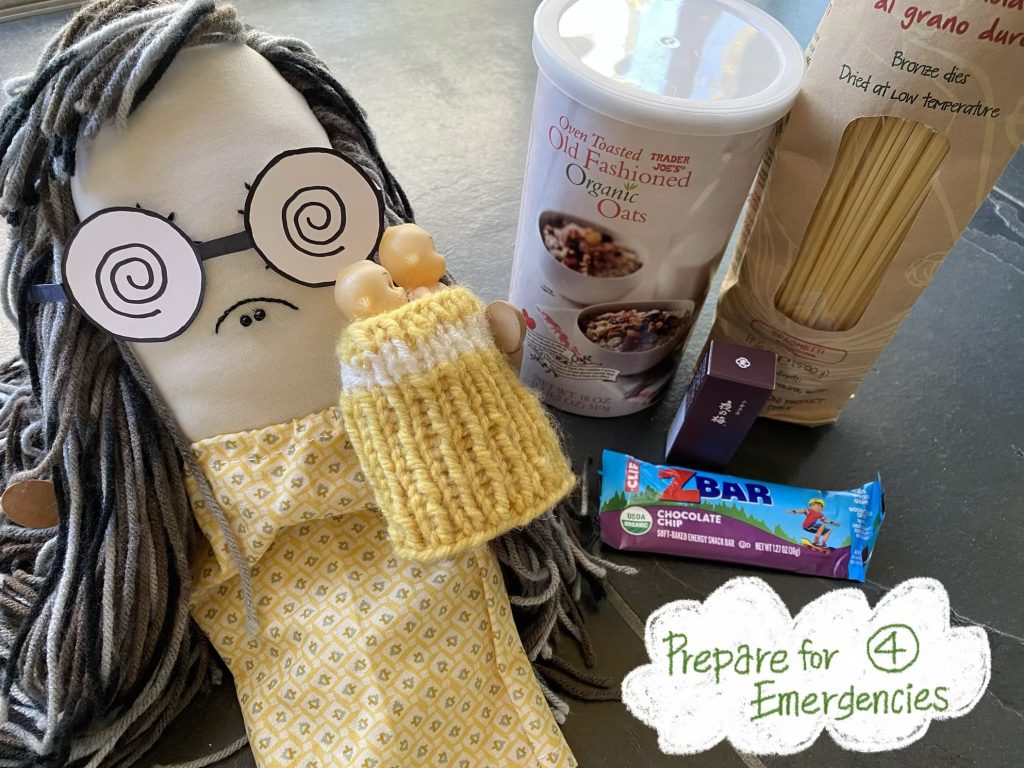
What you need to know before you start preparing emergency food and formula for your baby .
Do I need to get specific types of baby formula and food for emergencies?
I hope I will be able to get baby food from an evacuation shelter…
Is it possible to keep breastfeeding after major disasters?
Preparing baby food and formula for emergencies is actually not so easy. You may think that it’s simply a matter of getting some extra supplies and then setting them up in your home; or maybe just picking up relief supplies later on, when you need them…
But be careful! There are pitfalls you need to look out for.

What you should know about evacuating with your baby. #103
The pitfalls of preparing emergency food.
★ Difficulty communicating
Remember, babies and small children can not talk. They cry, babble, or use a few simple words to get their point across, but that’s about it. Also, they don’t fully understand their current situation, whatever it happens to be. Even when there is no choice of which food to eat, they might still be picky. They might turn their noses up at relief supplies, putting you in a tough situation.
You should stock up on your baby’s favorite foods,
and make sure you have them available for emergencies.
My babies’ pacifiers were the most critical items.
When I didn’t have them, I felt I was caught in my babies’ own emergencies.
★ The food you have may not suit your child’s tastes.
Do you think if your baby is super hungry, they will eat whatever you have available, in an emergency situation?
How many days do you need for your children to get used to a crisis situation?
If your children are picky eaters,
they will likely still be picky eaters in emergencies, maybe even more so.
Have you ever tried emergency rations? Do you think everyone can stomach the relief supplies and emergency food that’s available after a large-scale disaster?
I don’t think so.
Especially kids.
Adults can be patient and can appreciate whatever kind of food they are able to find in an emergency. We adults, if we’re stuck in difficult circumstances, have enough perspective to understand the gravity of our situation, and can compromise. Even if our food tastes bad, we can eat it. But how about babies and small children?
Some children might need to have a full-on breakdown from hunger before they understand.
★ It might be difficult to get appropriate food for each age group.
Each baby grows at their own speed. The stages of development, like learning how to chew and swallow solid food, or growing teeth, happen at different times for each child.
Do you think the government’s relief supplies will include appropriate food items for each stage of your baby’s development?
I think immediate relief supplies will not, but eventually… maybe…?
★ Special requirements for expectant mothers.
Pregnant women might be limited in what they can eat. Morning sickness will often dictate what expecting moms can and can’t eat. Pregnant women also need to be careful about what they eat because of a higher risk of bacterial infection. Expectant moms need to consider their individual circumstances to adequately prepare for their own special requirements.
FOOD TO AVOID DURING PREGNANCY
| DON’T EAT THESE FOODS | WHY? | WHAT TO DO |
|---|---|---|
| Soft CHEESES made from unpasteurized milk. Don’t eat brie, feta, Camembert, Roquefort, queso blanco or queso fresco. | May contain E. coli or listeria. | Eat hard cheeses, such as Swiss. Or check the label and make sure it is made from pasteurized milk. |
| Don’t eat raw COOKIE DOUGH or CAKE BATTER. | May contain salmonella. | Bake the cookies and cakes. Don’t lick the spoon. |
| Avoid eating certain FISH: shark, swordfish, king mackerel and tilefish. | Contains high levels of mercury. | Eat up to 12oz per week of fish or shellfish that are lower in mercury, such as shrimp, salmon, pollock, and catfish. |
| Don’t drink unpasteurized JUICE or CIDER (including fresh squeezed). | May contain E. coli. | Drink pasteurized juice instead. |
| Stay away from unpasteurized MILK. | May contain bacteria. | Drink pasteurized milk. |
| Don’t eat SALADS made in-store, such as ham salad, chicken salad, or seafood salad. | May contain listeria. | Make salads at home following food safety basics: clean, separate, cook and chill. |
| Steer clear of raw SHELLFISH, like oysters and clams. | May contain vibrio bacteria. | Cook shellfish to 145 degrees F. |
Be careful with all prepackaged meats. Heat them to 165 degrees F, internal temperature before eating them. All products containing eggs should be heated to 160 °F. Meat, including ground meat, should be heated to 160 °F. Poultry (and stuffing) should be heated to 165 °F.
Fish should be heated to 145 °F prior to eating.
From Women’s Care Center.
Find more information about food during pregnancy at the Mayo Clinic website.
★ Food allergies
People with food allergies will have difficulties after a major disaster. Babies and small children with allergies, especially, will require extra attention, patience, and care to find the right food. After a major disaster, it will be difficult to get allergen-free meals due to supply chain disruptions and damaged infrastructure. Food at evacuation shelters will be of limited variety. Government emergency supplies will likely not meet special requirements for the most vulnerable and sensitive.
If your baby has special needs, and you don’t prepare adequately, you could find yourself in a very bad situation. You might have to choose between the risk of an allergic reaction and going without food. Both choices could lead to serious health conditions.
I used to carry extra food all the time, until my kids became teenagers.
Hungry kids are difficult.
If your child has allergies, you should be aware of something called cross-contact (check out more at the FARE, Food Allergy Research & Education website). In short, cross-contact is when a small amount of an allergen accidentally contaminates some other food. This can be dangerous as it can trigger a life-threatening allergic reaction. Surely, you will be grateful to receive emergency food at an evacuation site, but stay alert. Cross-contact can happen anytime, anywhere.
The 2016 Kumamoto Earthquake in Japan adversely impacted children with food allergies.
Check out this study from NIH ( National Library of Medicine).
★ Formula might be OK but how about the water?
After major disaster, tap water may not be safe to drink, and if it’s not safe to drink, then it’s also unsafe to mix with powdered infant formula (check post #7). Unless you have access to bottled water, or some other fresh water source, you’ll be stuck. Just having baby formula is not enough; you also need clean water. Power outages, damaged pipes, and blocked roads are all very real problems that can cut off your access to potable tap water. For the sake of yourself and your family, you need to think about this, and you need to prepare.
I discuss water in greater detail, in my previous post, #105.
Tips
▪︎ You must prepare emergency food in your home, in your evacuation bags (see post #52), and in your car.
▪︎ Try eating some of your emergency food. You need to know, in advance, before you need it, whether or not your kids can eat it.
▪︎ Check your city’s disaster plan. How much baby food and allergen-free food do they have stockpiled for emergencies.
▪︎ Pregnant women should learn how to breastfeed. Breastfeeding is a life-saving protection in an emergency. (Find more info on this topic in post #105.)
▪︎ Keep breastfeeding as long as possible. Do your best to avoid switching to powdered formula. You might think the stress of a disaster will affect your milk production, but actually it will not, so long as you keep breastfeeding regularly and get plenty of water and food for yourself.
▪︎ If you’re a mom who has a child with food allergies, research how to make meals from the relief supplies you might get during a disaster. The skills you acquire will be useful to other moms too, during a crisis.
▪︎ Find ways to protect against your child being a picky eater. Either stock up on the foods they like, or encourage them to branch out.
▪︎ Choose between simple, homemade baby food and instant baby food. Try them out, in advance, to prepare yourself for emergencies.
Personally, I recommend making simple, homemade baby food,
because if you find yourself in a worst case scenario (check out the long-term emergency in post #40),
you will have little choice but to give your child bland, flavorless food.
There are two major issues facing Japan, today: the declining birthrate and the aging population. The two issues are related, and as each issue becomes more serious, it seems to exacerbate the other, like a feedback spiral. Questions about how best to support pregnant women and babies in emergency situations tend to take a back seat to those two major issues.
I think they are not only Japanese problems. Other countries appear to have the same or similar population problems.
Anyway, we must prepare emergency foods for our babies and small children. We must do this by ourselves, and we must do it now.
I will explain how to make a simple DIY baby meal from rice, in my next post. And I’ll talk about emergency formula alternatives, in a future post.
Please check it out.
See you next time.
Remember, “Protect your life by yourself” (自分の命は自分で守る). You need to survive first, and then you need your emergency supply. No matter how well you prepared your emergency supplies, if you die, then all of your preparations will have been for nothing. First and foremost, keep your health up all the time. Build your stamina so that if you need to, you can evacuate as quickly as possible. Stay healthy.
